Shaft Collars in Modern Machinery: Functionality, Material Evolution, and Application-Specific Insights
In mechanical assemblies of all sizes—ranging from automation lines to medical devices—the shaft collar plays a deceptively minor but strategically vital role. This small, often circular component is designed to clamp or locate components on a shaft. Despite its simple geometry, it has become a staple component in modern machinery, offering mechanical stops, bearing faces, and mounting positions.
The shaft collar's enduring relevance lies in its versatility, ease of use, and ability to serve as a reliable fastening and positioning tool without complex machining.
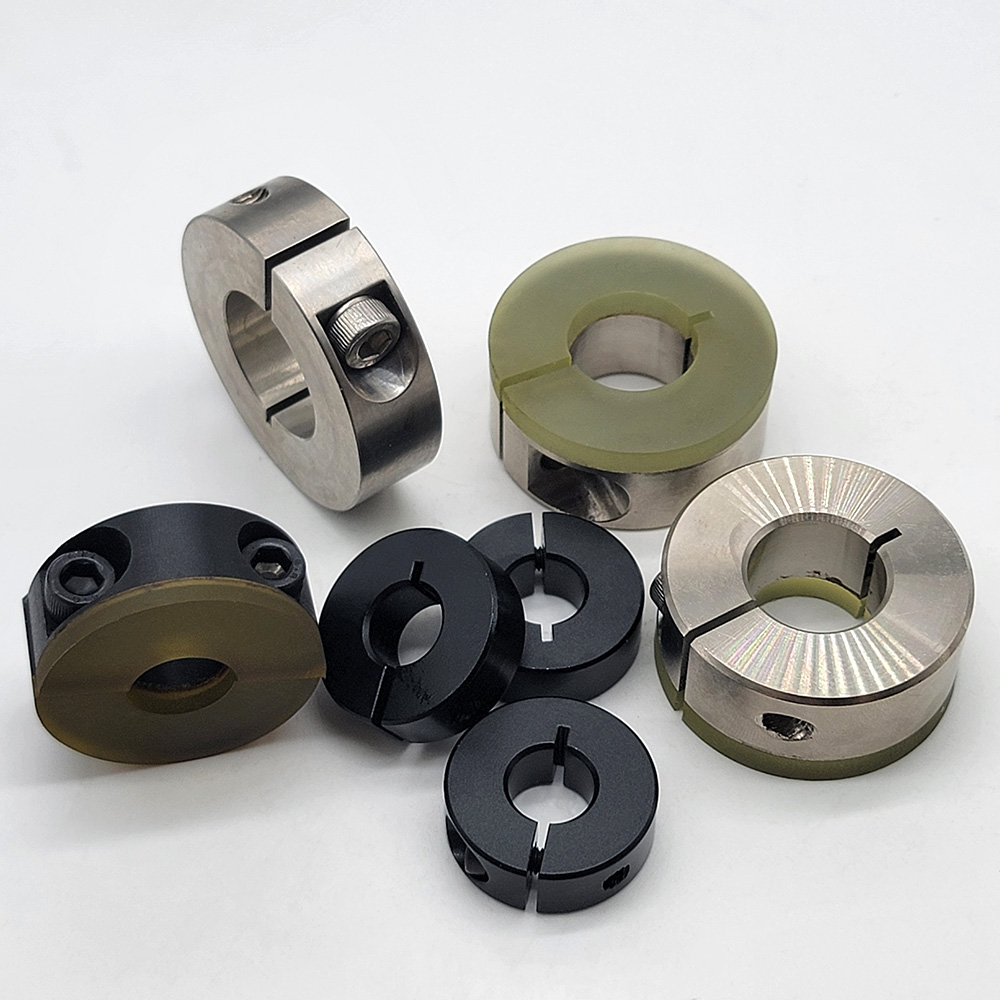
What Is a Shaft Collar?
A shaft collar is a mechanical component mounted on a shaft that serves several key functions:
- Acts as a mechanical stop to prevent parts from sliding axially
- Holds bearings or sprockets in precise positions
- Serves as a mounting point for other components
- Supports torque transmission in coupling assemblies
Shaft collars are commonly circular, but can also be D-shaped, hexagonal, or custom-formed for specific shaft geometries.
Main Types of Shaft Collars
The functionality and reliability of shaft collars are largely dependent on their design type. Each has its advantages and suitable use cases.
1.Set Screw Collars
- A basic collar with a set screw that bites into the shaft surface
- Common in simple, low-torque applications
- May damage shaft surface and requires precise tightening
2.One-Piece Clamp Collars
- Slips over the shaft and clamps uniformly via one tightening screw
- Offers superior holding force without damaging the shaft
- Easy to install and reposition
3.Two-Piece Clamp Collars
- Can be installed without removing other components from the shaft
- Provides greater clamping force due to dual screw action
- Ideal for maintenance and reconfiguration
4.Threaded Shaft Collars
- Internally threaded to mate with threaded shafts
- Used for axial adjustment and locking
- Found in motion control assemblies
5.Hinged Collars and Quick-Release Variants
- Designed for rapid setup and teardown
- Used in production fixtures and testing equipment
- Reduces downtime significantly
Materials and Surface Treatments
The material selection of shaft collars determines not only mechanical performance but also compatibility with the operating environment. The common options include:
1.Carbon Steel
- Cost-effective and strong
- Typically black oxide coated for corrosion resistance
- Used in general industrial environments
2.Stainless Steel
- Corrosion-resistant, ideal for medical, food-grade, or marine applications
- Non-magnetic variants available
- Suitable for wash-down and high-humidity environments
3.Aluminum
- Lightweight, corrosion-resistant
- Used in weight-sensitive assemblies like robotics and packaging machines
- Often anodized for durability and color-coding
4.Often anodized for durability and color-coding
- Lightweight and non-conductive
- Suitable for cleanroom, laboratory, and electronics
- Not ideal for heavy load-bearing tasks
5.Titanium and Special Alloys
- Selected for aerospace or medical-grade precision equipment
- Combines strength with minimal weight and excellent corrosion resistance
- Combines strength with minimal weight and excellent corrosion resistance
Functional Advantages of Shaft Collars
Despite their simple construction, shaft collars provide multiple mechanical and practical benefits:
- Ease of Installation: Most can be installed with basic tools in seconds
- Precise Positioning: Holds components in accurate axial position
- Reusability: Can be removed and repositioned multiple times
- Shaft Protection: Clamp-style collars prevent marring or deformation
- Versatile Use: Functions as a mechanical stop, bearing face, spacer, or structural attachment
Shaft collars may be modest in appearance, but their contribution to machine alignment, motion control, and equipment safety is substantial. Whether in the form of a simple clamp on a shaft or as part of a precision robotic assembly, their role is undeniable.
Understanding the nuances of design selection, material compatibility, and installation technique is essential for engineers and purchasing managers seeking reliability, durability, and maintenance efficiency in mechanical assemblies.
Polyurethane Roller&wheel
Shock Absorbing Products
Pulley Wheel
Rack And Pinion
Ball Transfer Unit
Spring Plunger
CNC Parts