In mechanical systems where synchronization is critical, timing belt pulleys play an indispensable role. From automated machinery to internal combustion engines, these components enable accurate transmission of motion and power without slippage, ensuring precise mechanical coordination between rotating shafts.
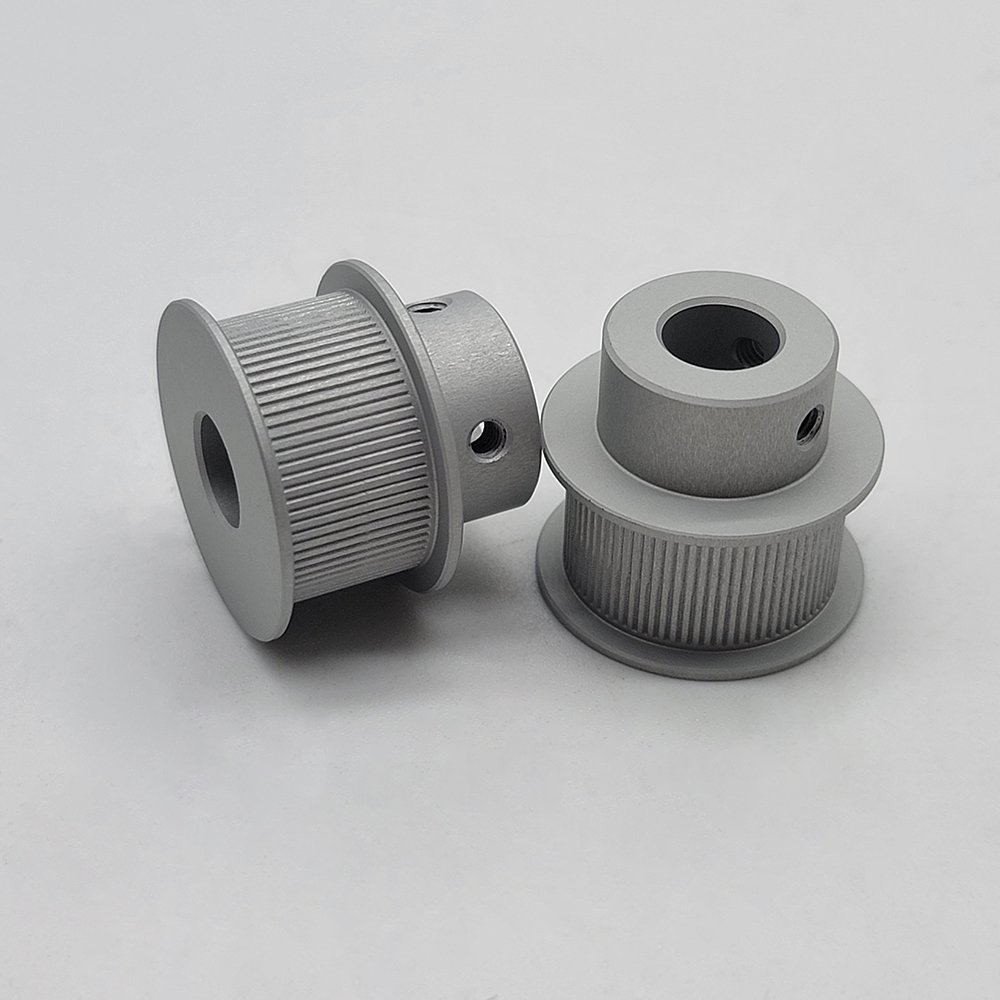
What Is a Timing Belt Pulley?
A timing belt pulley is a rotating mechanical element featuring teeth that interlock with a matching toothed timing belt. Unlike flat or V-belt pulleys, the toothed profile prevents slippage, allowing the pulley to transmit motion with high precision. The combination of the belt and pulley creates a positive drive system, where motion between shafts is perfectly synchronized.
The design is ideal for applications where:
- Positional accuracy is essential
- Timing between machine components must be maintained
- High torque needs to be transmitted at relatively low speed
- No lubrication is desired
Common examples include 3D printers, CNC machines, packaging equipment, textile machinery, robotics, and automotive camshaft drives.
Anatomy of a Timing Belt Pulley
A standard timing pulley has the following features:
- Toothed Profile
Teeth spacing matches the pitch of the timing belt. Tooth shapes vary by system (e.g., trapezoidal, curvilinear, modified curvilinear).
- Flanges
Prevent lateral movement of the belt, especially in high-speed or vertical systems.
- Bore
Central hole where the pulley is mounted to a shaft. May be plain bore, taper-lock, or keyed.
- Keyway / Set Screw
Secures the pulley to the shaft to prevent slipping.
- Hub
A protruding section for extra material, allowing connection to shafts, bearings, or couplings.
Types of Timing Belt Pulley Profiles
Pulley teeth are standardized by several international profile systems. Common ones include:
| Profile Type | Description | Use Case |
| MXL, XL, L, H | Trapezoidal tooth | Light to medium-duty systems |
| T (T2.5, T5, T10) | Metric trapezoidal | General-purpose motion |
| HTD (3M, 5M, 8M, 14M) | High Torque Drive | Industrial machinery |
| GT2, GT3, GT5 | Curvilinear (Gates) | Low backlash, 3D printers |
| RPP | Reinforced parabolic | Higher torque load |
| AT5, AT10 | Modified trapezoidal | Higher strength and accuracy |
To match a belt and pulley system, the pitch, width, and tooth shape must be compatible
Materials Used in Timing Belt Pulleys
The choice of material impacts wear resistance, torque capacity, weight, and cost.
Aluminum Alloy
- Lightweight and corrosion-resistant
- Easy to machine
- Common in automation and robotics
- Often anodized for durability
Steel
- High strength for torque transmission
- Used in high-load or harsh environments
- Often used in office equipment or consumer devices
Plastic / Engineering Polymers (e.g., POM, Nylon)
- Lightweight and quiet
- Suited for light-duty or cost-sensitive applications
- Often used in office equipment or consumer devices
Stainless Steel
- Corrosion resistance for food or medical equipment
- Slightly heavier than aluminum
Timing belt pulleys are essential components in modern mechanical systems that require accurate and slip-free motion transmission. Their ability to synchronize rotary motion with consistency and minimal maintenance makes them indispensable across a broad spectrum of industries—from automation and medical to textile and automotive.
Polyurethane Roller&wheel
Shock Absorbing Products
Pulley Wheel
Rack And Pinion
Ball Transfer Unit
Spring Plunger
CNC Parts